Dear Mission Partner (and other interested readers),
Every time a gift reaches you on the field, or a prayer update goes out to Churches back home, you're taking part in something that started 130 years ago with one man, one bicycle, and a calling he couldn't ignore. We wanted to write to you, not just about you, because you're not reading someone else's history. You're living the next chapter of it.
In February 1896, a young man named James Kirk left Owaka, in South Otago, and set out for Argentina. He is remembered as the first missionary ever commended by a New Zealand Open Brethren assembly for overseas service, and he would go on to serve in Argentina for fifty-six years. Kirk wasn't sent by an organisation - he was commended by his home Church, which trusted God to provide for him through the gifts of ordinary believers. No head office decided he should go; a Church family did, on its knees, and then kept faith with him for over half a century.
That is the pattern you belong to. Local Churches sending and supporting their own people. It's also what created the need for what would eventually become GC3.
A channel for gifts and news
As more workers followed Kirk's example, New Zealand Open Brethren Churches needed a reliable way to send money and information to missionaries scattered around the world. From 1899, a magazine called The Treasury carried "Missionary Intelligence," reports from the field and updates on gifts sent and received. Over the following decades, that informal channel became Missionary Funds (N.Z.) Incorporated, based in Palmerston North. Long before emails and bank transfers, this was how a Church in Palmerston North stayed connected to a family serving on the other side of the world. The mechanics have changed since. The instinct behind them hasn't.
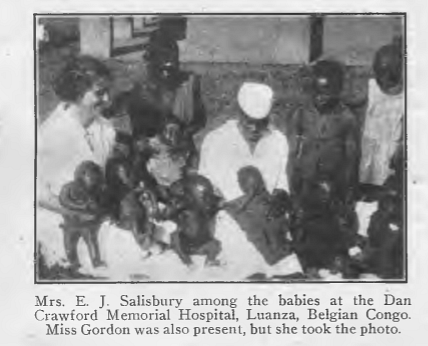
Photo above The Treasury, 1936
Decades of sending
From that single departure, the movement grew steadily outward: to Malaya and India in the 1900s, Paraguay and Argentina, the Zambia-Zaire border region, Chad, Palestine, Fiji, Brazil and Central Africa through the 1920s and 30s. The Second World War touched the movement directly, with several workers arrested or interned overseas. After the war, New Zealanders were commended to Italy, Japan, Papua New Guinea and beyond.
By 1996, New Zealand assemblies had commended and supported more than 800 missionaries in over 50 countries. Eight hundred stories, each one beginning the way yours did: with a calling, a sending Church, and a step of faith.
A parallel story: Gospel Literature Outreach (GLO)
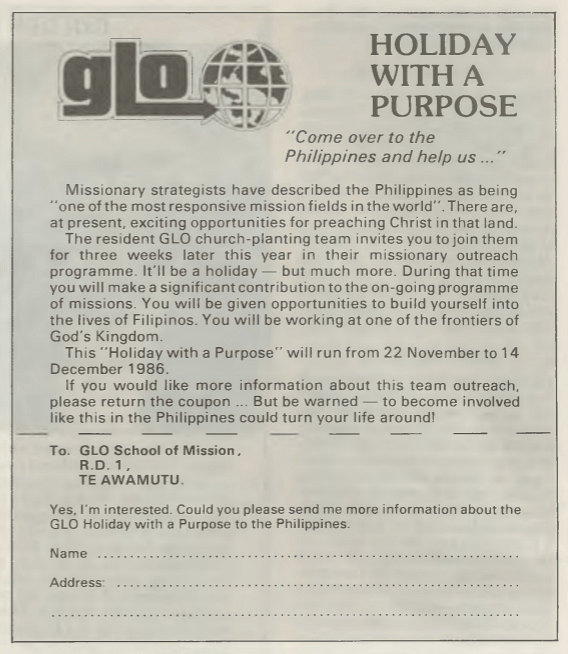
While Missionary Services grew out of Kirk's generation, a second stream of New Zealand mission developed in parallel. Colin Tilsley, born in India to Brethren missionaries, launched Gospel Literature Outreach (GLO) as an organisation in Australia in 1965.
GLO's New Zealand workers first went to Brazil in 1967. By 1970, they had also opened work in Italy and, through a mission based in Marseilles, in France. In 1975, GLO set up its own training centre in New Zealand, preparing many students and families for mission, discipleship and leadership over the following decades. Two rivers, running from the same source, both feeding the same sea.
Growing to meet new needs
In 1991, the organisation renamed itself Missionary Services (NZ) Incorporated, reflecting a broader role: alongside remitting funds, it now offered practical support on tax, medical and insurance advice, travel and resettlement. In 2001, the two streams, Missionary Services and GLO, combined to form Global Connections in Mission, bringing together decades of experience in remitting funds, sharing prayer and reports, and resourcing Church leaders and missionary personnel.
Through the 2000s, the organisation grew a full gap-year programme (Headspace) and a dedicated relief and development arm, responding to disasters like Cyclone Nargis and the Sichuan earthquake, and supporting longer-term projects such as tsunami relief in Chennai, India.
By 2012, the organisation had adopted the name GC3, reflecting its three linked trusts working under one identity: Global Connections in Mission, GC Assist and GC Aid.
What hasn't changed
The names have changed. Missionary Funds. Missionary Services. Global Connections in Mission. GC3. But from Kirk's departure in 1896 to your own work today, the purpose underneath every name has stayed exactly the same: New Zealand Open Brethren Churches, trusting God, sending their own people and resources into the world to fulfil the Great Commission (Matthew 28:18-20).
So here is what we want you to know. You are not on the field alone, and you never have been. Behind you stands a long line of NZ Open Brethren (Heritage) Churches and ordinary believers who have kept faith with this calling since Kirk first climbed onto that bicycle, and a team at GC3 whose whole job is to keep that same channel of support, prayer and encouragement open for you today.
The structures around you may look different from 1896. The purpose you're serving is exactly the one Kirk stepped into all those years ago.
Thank you for carrying it forward. That thread now runs unbroken for one hundred and thirty years, and you are holding your part of it.
With thanks,
Michael Hanson
Executive Director, GC3