
Earlier this year, Michael Hanson had the opportunity to speak at Hope Community Church in Nelson and reflect on the rich missionary heritage connected to the region.
As he shared stories of men and women sent out from Nelson to serve across the world, one family in particular stood out : the Shirtliff family.
In 1898, five missionaries left New Zealand for Malaya. Four of them were single women. One of those women was Sarah Shirtliff from Nelson.
Few could have imagined at the time that Sarah’s decision to leave home would become the beginning of a remarkable family legacy of service stretching across Malaya and India for decades to come.
Over the years, four of Sarah’s sisters would also serve overseas : Bessie, Clare, Kath, and Julia Shirtliff : each contributing in different ways through teaching, medical work, visitation, discipleship, and practical care. Together, the Shirtliff sisters became part of the early foundations of gospel witness and community care in parts of Southeast Asia and India during a significant period of change and hardship.
Michael also reflected on the ministry of Elizabeth Dron, who he noted was also connected to the wider Nelson region, and who travelled to Malaya in 1898 alongside Sarah Shirtliff. Elizabeth was only 22 years old when she left New Zealand.
Although not formally trained as a teacher, Elizabeth served in isolated conditions in Penang before later marrying missionary George Wilson in 1902. Together they became closely involved in ministry work in Ipoh, including the development of Elim Gospel Hall, outreach into surrounding villages, and care for orphaned children.
Historical records describe George Wilson travelling between towns by bicycle and motorcycle to preach and distribute Scripture, while Elizabeth helped establish practical ministry amongst women and children. Their work became part of the wider network of early missionary activity taking place across Malaya during that period.
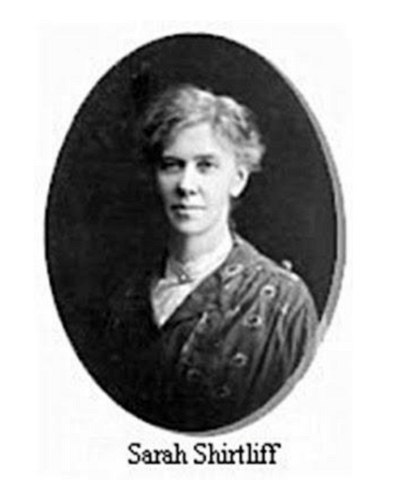
Sarah Shirtliff : A ministry of Presence
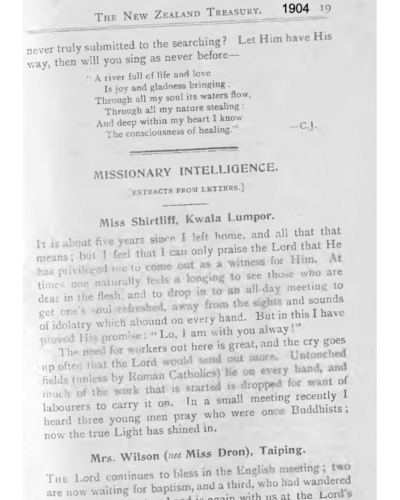
Sarah Shirtliff arrived in Malaya in October 1898 and began ministry amongst women, children, and leprosy patients around Kuala Lumpur.
Much of her work was built through years of visitation, conversations in homes, practical care, teaching, and faithfully walking alongside people. She spent time helping in dispensaries, schools, and amongst women in villages and on rubber plantations. Later, she undertook medical training in the United Kingdom to broaden her ability to serve.
From 1921 onwards, Sarah became increasingly involved in ministry amongst leprosy patients near Kuala Lumpur. At the time, the leper settlement was growing rapidly. By 1939, more than 2,300 patients were living there.
Despite the difficult conditions, Sarah and her fellow workers were granted access into the camp for gospel ministry and pastoral care. In 1932, permission was given for a hall to be built within the settlement itself : a significant milestone for the growing Christian community amongst the patients.
Sarah also remained deeply connected with the wider Chinese community in Kuala Lumpur and was known for her care, consistency, and personal relationships.
When the Japanese invasion began in 1941, Sarah was evacuated to Singapore and later travelled to India. After several years of illness and recovery, she returned to Kuala Lumpur in 1946 : the first of the New Zealand missionaries to return following the war.
Less than a year later, on 22 February 1947, Sarah entered her eternal home at the age of 75.
A family that continued to serve
Sarah’s story was not an isolated one.Her sister Bessie Shirtliff travelled to Malaya in 1904 and joined Sarah in Kuala Lumpur. Together they travelled to China for language study in 1905. Bessie later taught in a Chinese girls’ school, helping provide education alongside Christian teaching for young women in their formative years.
Another sister, Clare Shirtliff, arrived in the Malay States in 1919. What began as temporary help in schools soon became a decade of deeply integrated ministry.
Clare taught English, learned the Malay language, visited homes, ran Bible studies, distributed Scriptures, and supported women and young people across the region. Much of her work centred around Ipoh, where she became closely involved in the life of the local Christian community. During the upheaval of World War II, Clare was evacuated alongside Sarah to India, where they joined their sister Kath.
Kath Shirtliff served for many years in India teaching at schools for missionaries’ children, including Hebron School. She retired in 1945 after long years of faithful service.
Their sister Julia Shirtliff trained in general nursing and midwifery at Nelson Hospital before travelling to India in 1907. There she learned the Malayalam language and later married Edwyn Noel, another New Zealand missionary.
Together, Julia and Edwyn Noel became part of extensive ministry work amongst local communities in South India. Their ministry included Bible teaching, village visitation, evangelism, medical work, schools, leadership training, and literature distribution.
By the late 1930s, thousands of children were hearing Scripture daily through schools connected to the work, and many local believers and evangelists were actively leading ministry throughout the region.
A legacy beyond one generation
The story of the Shirtliff sisters is not simply a story of travel or pioneering effort. It is a reminder of the long, faithful work that often sits quietly behind the growth of churches, schools, ministries, and communities. Their contribution was expressed through practical service, hospitality, teaching, pastoral care, endurance through war and illness, and a willingness to remain present amongst people over many years.
Many of the places they served were challenging and isolated. Much of their work would never have drawn public attention. Yet through ordinary acts of faithfulness, generations of people were impacted.
Today, their story remains part of the wider history of New Zealanders participating in God’s mission across cultures and nations.
Sources
This article has been researched by Michael Hanson using historical missionary records and publications, including:
In His Name: A Record of Assembly Missionary Outreach from New Zealand by Les A. Marsh and Henry D. Erlam
Historical missionary records relating to Sarah, Bessie, Clare, Kath, and Julia Shirtliff
Historical accounts connected to Elim Gospel Hall, Ipoh, Malaysia
Historical records relating to Edwyn and Julia Noel’s ministry in South India
Primary source references used in preparation of this article include:
Sarah Shirtliff missionary record (1898)
Bessie Shirtliff missionary record (1904)
Clare Shirtliff missionary record (1919)
Kath Shirtliff missionary record
Julia Shirtliff / Mrs E. Noel missionary record (1907)
Edwyn H. Noel missionary record (1904)
Historical article: Five Brethren missionaries left for Malaya in 1898
Researched and compiled by Michael Hanson.