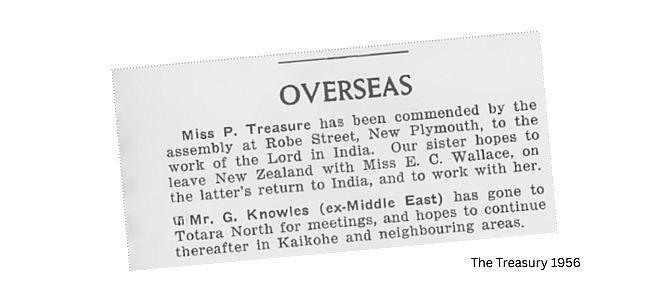
In The Treasury of August 1956, Phyllis Treasure’s name appears under the heading Overseas, briefly recording that she was commended by the assemblies at Armagh Street, Quinn’s Road, Christchurch and Robe Street, New Plymouth for overseas service in India. In true economical word count of that print era, information was limited. There is no commentary on this lifetime commitment and its possible significance. The notice simply marks a step taken.
From The Treasury, August 1956
“Miss Phyllis Treasure has been commended by the assemblies at Bourke Street and Quinn’s Road for overseas work in India.”
Raised in a Christian home in Christchurch, Phyllis grew up with an awareness of missionary work as part of regular church life. As a teenager, she received a Sunday school prize, which she later commented “was a beautiful book of stories about missionary service in China”. One story prompted her to question her own willingness to be obey a calling to serve. She at the time she did not share this publicly, and it came with no immediate direction.
Several years passed. Phyllis studied home science at university, trained as a teacher, and began working in New Plymouth. Throughout this time, she carried a sense that her life was held for God’s purposes, even though no clear opportunity for overseas service emerged.
She met a missionary home on furlough who needed someone to return overseas with her. Phyllis recognised this as God's calling that she had been waiting for, though accepting it required considerable faith.
Leaving New Zealand at that time in the 1950s meant long separation from family and very limited communication. Phyllis spent a year weighing the decision, seeking the Lord’s confirmation through prayer. When she eventually shared her decision with her parents and church community, the response was very affirming. Several people indicated they had long sensed her life was being shaped for this kind of service.
Following her commendation, The Treasury continued to record her progress in a factual way. Notices referenced her linguistic training in Melbourne and later her ongoing work in India.
From The Treasury, late 1950s
“Miss Treasure is undertaking linguistic training in Melbourne in preparation for her work overseas.”
When health concerns required adjustments, these too were noted briefly and without commentary, reflecting an understanding of the practical realities of long-term overseas service.
Again, from The Treasury,
“Prayer is requested for Miss Treasure as she adjusts her work due to health.”
The records also show consistent connection between Phyllis and the NZ churches that supported her. She travelled between assemblies before leaving New Zealand, building relationships and inviting prayer. These connections endured for decades and became, as she later acknowledged, a significant source of strength.
You may have heard many stories of the incredible work Rehoboth in Kerala, India where Phyllis still lives today. Phyllis is affectionately referred to as “Mummy” by all who know her throughout India. As you sit and learn from Phyllis, you notice that she has not framed her years of service in terms of achievement, but as faithfulness to what she believed she had been called to do.
Seventy years on, it seems that what began as a single line in The Treasury has become a remarkable story of a faithful life-long commitment to service.
You can learn more about the work of Rehoboth here.